Baby Crib Toy Animated Gif Sheep Animated Gif
Email is an effective communication channel for companies to connect and maintain relationships with customers. With the growth of social-media platforms as useful customer-engagement channels, many people assume email marketing has become less relevant and effective. That's wrong. In its annual Country of Email survey, email-testing platform and marketing-research group Litmus reported that the return on investment (ROI) for email marketing is still very strong: on average, for every dollar invested, the return is $38.
For that reason, we continue to report the user feel of newsletters and marketing email. When we conducted research for the sixth edition of our report, Marketing Email and Newsletter Design to Increase Conversion and Loyalty, we saw a surge in the utilise of animated GIFs in the emails we tested. The acronym, GIF, stands for Graphic Interchange Format, which is a digital-prototype file format where multiple frames are encoded into a single file. Email clients and web browsers tin play GIF images in an animated sequence resembling a brusk repeating video. The use of this dynamic-content type is widespread in email marketing. Litmus indicated that 57% of marketers reported using animated GIFs at least sometimes in their email campaigns. Many email-entrada tools and platforms tout the effectiveness of animated GIFs in increasing marketing-e-mail engagement, but in that location is little insight into how users perceive this content.
Methodology
To explore this question, we conducted two online surveys. We showed 14 unlike marketing emails with a variety of animated GIFs to a sample of 55 respondents. We also created a corresponding static version of each of these emails using a unmarried frame from each. These static variations were shown to a unlike set of 66 respondents.
For each of the 14 emails, we asked respondents to draw the email past selecting 3 words from a given listing of reaction words (a modified Microsoft Desirability Toolkit examination). The word list provided included 30 total reaction words, 18 of which were positive and 12 of which were negative. (Of form, respondents saw the words in a unmarried mixed list, only, for clarity we're showing yous the words divided into two lists.)
| Positive | Negative |
| 1. Appealing | one. Annoying |
| 2. Compelling | ii. Unrefined |
| three. Cut edge | 3. Cheap |
| iv. Exciting | four. Complex |
| 5. Friendly | 5. Confusing |
| 6. Engaging | 6. Ineffective |
| 7. Inspiring | vii. Tiresome |
| viii. Motivating | 8. Distracting |
| 9. Professional | 9. Dull |
| 10. Relevant | 10. Frustrating |
| 11. Satisfying | xi. Impersonal |
| 12. Articulate | 12. Incomprehensible |
| thirteen. Straight Forrard | |
| 14. Powerful | |
| fifteen. Stimulating | |
| 16. Creative | |
| 17. Fun | |
| 18. Helpful |
In addition, we selected a small subset consisting of iv of these emails and asked respondents to rate the value of the emails based on a 7-bespeak semantic differential scale (1 = non at all valuable, 7 = extremely valuable). For the same subset of emails, we asked them to charge per unit how trustworthy they felt the email was (1 = not at all trustworthy, 7 = extremely trustworthy).
The emails selected were all real marketing emails from online retailers. In both surveys, the emails were presented in a random club. The survey respondents used a desktop or laptop device in order to see these emails.
Two examples of the total fix of stimuli tested are shown below.
Emails Without Animation Were Described in More Positive Terms
When nosotros asked people to select 3 words from a list of positive and negative terms, respondents selected more positive reaction words and fewer negative reaction words for the emails with static images compared to those that had animated images. On average, an email with animation received 1.7 negative words and ane.3 positive words, whereas an email without blitheness received 1.2 negative words and i.8 positive words. Both these differences were statistically meaning at p < 0.005.
In other words, adding animation to an email increased its negative word count past 40% and decreased its positive word count by 30%.
If we were to quantify the positive sentiment elicited by an email as the departure between the average number of positive words and the average number of negative words, past adding animation to an email, the positive sentiment towards that email decreases by 165%. (That's because the positive sentiment for an electronic mail without animation is 0.55, while the positive sentiment for an email with animation is -0.36. Negative numbers mean that the sentiment is predominantly negative.)
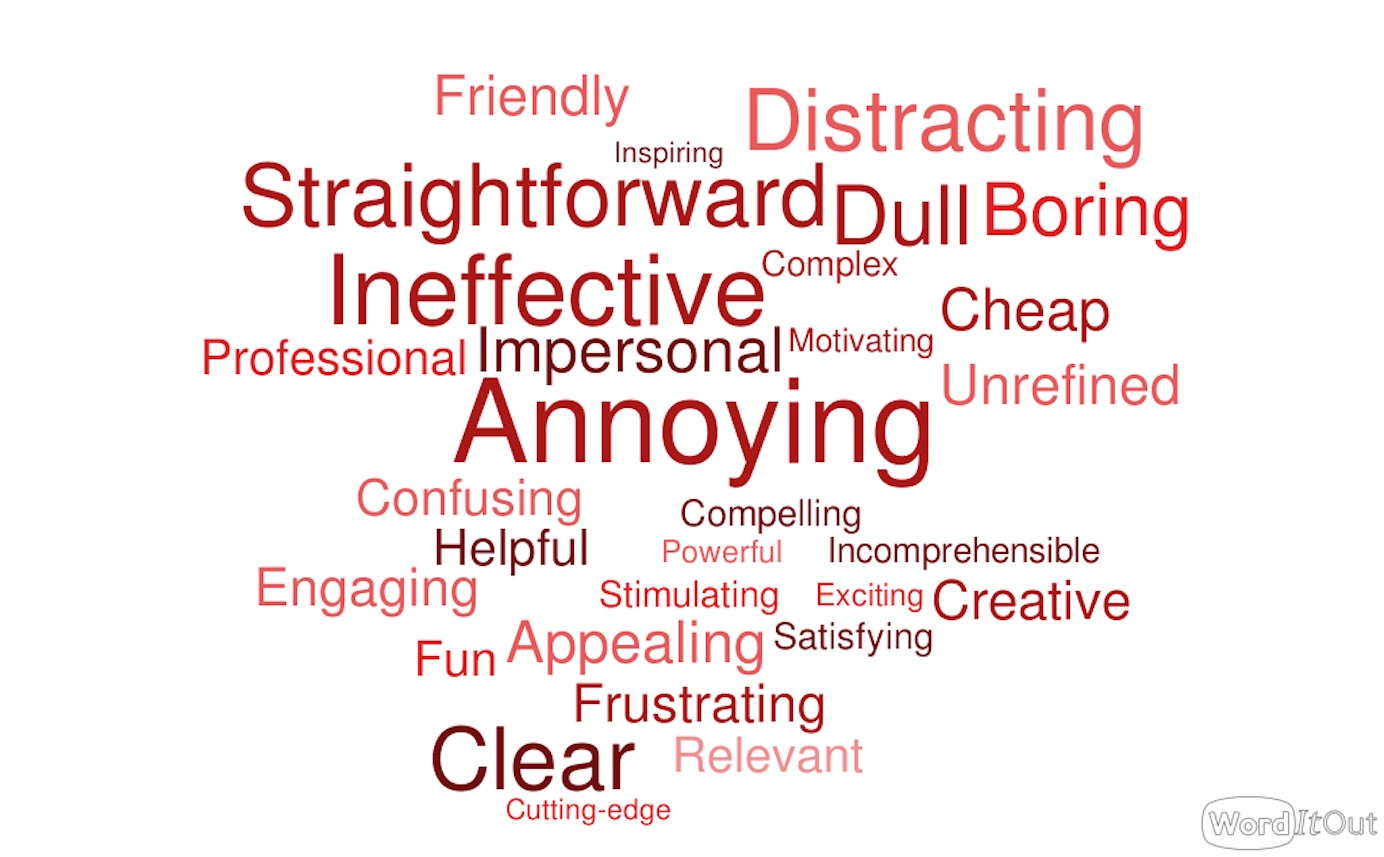
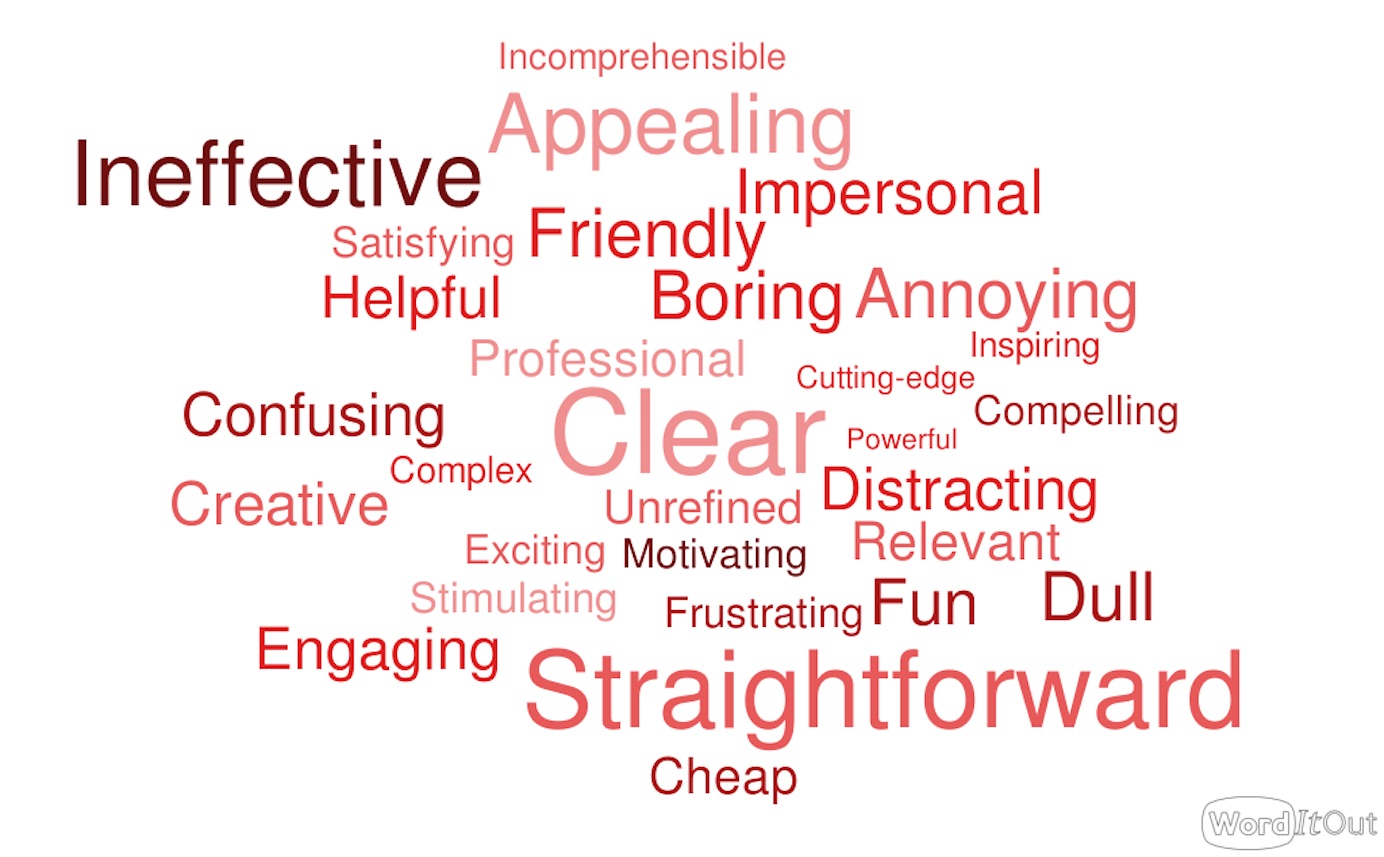
The words with the largest differences in the number of selections beyond stimuli are outlined below. These numbers indicate the boilerplate number of times these words were selected by respondents for the 14 emails beyond both variations.
Average Percentage of Users Who Selected Each Word for an Email: Animated vs. Static Emails | ||||
| Give-and-take | Blazon | Animated GIFs | Static Images | Give-and-take |
| Annoying | Negative | 31% | xiv% | Selected much more often for emails with blithe GIFs |
| Distracting | Negative | twenty% | 11% | |
| Ho-hum | Negative | 20% | 13% | |
| Appealing | Positive | 11% | 18% | Selected much more than often for emails without animated GIFs |
| Clear | Positive | 21% | 27% | |
| Fun | Positive | seven% | 12% | |
Three negative words (Annoying, Distracting, and Ho-hum) were selected much more than frequently when participants viewed emails that contained animated GIFs. Three positive words (Highly-seasoned, Clear, Fun) were selected much more than often when participants viewed the variation of the electronic mail that did not incorporate animation. Differences between the rest of the words in the word list were less pronounced.
Emails Without Animated GIFs Were Seen equally More Valuable and Trustworthy
Across the sample of 4 emails where value and trustworthiness were assessed, the emails without blithe GIFs tended to be rated every bit more valuable than emails with blithe GIFs (three.69 vs 3.24 on a scale of 1 to 7). This difference was marginally pregnant when participants were treated equally the random factor ("beyond subjects"), just not pregnant when the emails were treated as the random factor ("across emails").
In other words, there is some express bear witness that emails without blithe GIFs are perceived as more valuable, but we would likely need more information to know for certain whether that is indeed the instance.
Emails without GIFs were also rated more trustworthy than emails with blithe GIFs (4.34 vs. 3.xc on a scale from one to seven). This difference was statistically meaning departure (p = 0.04) across emails, but just marginally significant across subjects (p =0.06).
Give-and-take
Before we swoop into a discussion of what these results might hateful, we should acknowledge the limitations of this study.
- We only used ecommerce marketing emails. Though animated GIFs are used in emails and newsletters from other types of websites, we did not have a large enough sample of similar emails outside of ecommerce. Thus, to ensure that all emails tested were of the aforementioned type, we restricted the written report to ecommerce marketing emails, where GIFs are widely used.
- Only 4 emails were included in the assay of value and trust. To limit the length of the survey, participants were just asked to charge per unit the value and trust on 4 of the 14 emails. These 4 emails may not be representative of all types of GIFs users would encounter in ecommerce marketing emails. For example, users may consider GIFs with product demonstrations equally more valuable. Nonetheless, even with this pocket-sized sample of emails, the higher averages of value and trust ratings for static emails are a compelling finding.
The results of this written report do imply that, on boilerplate, people accept a more than positive reaction to emails without blithe GIFs compared to those with blithe GIFs: not simply exercise they describe them using more positive words and fewer negative ones, only they likewise detect them more trustworthy and tend to assign a higher value to them.
Emails with animated GIFs are likely received more negatively for a diversity of reasons. One longstanding UX best do is that animations should be used judiciously and only for the clear purpose — for example, for providing feedback most land changes and data about how an interface functions. Beyond that, animations can be distracting to users, especially when they're unexpected. Users don't anticipate to see flashing colors and words when they open up a new electronic mail. In their words, it'south annoying and distracting. Information technology's difficult to read most an online sale or see what's existence offered with excessive and meaningless movement on the screen. These types of GIFs may seem a gimmick or a cheap try to get attention.
That said, not all animated GIFs are inherently bad. Some more conservative and meaningful animated GIFs may still be effective and welcomed past users. In the example beneath of a marketing email from Mr. Porter, the move of the flickering fire in the GIF is subtle and pleasing, doesn't impede on the bulletin in the electronic mail, and achieves the goal of providing movement to drag the prototype of the brand.

Additionally, animated GIFS tin can be quite constructive for demonstrating a product — for instance, this email from Bonobos shows recipients how the company'southward tear-away chinos pull away from the torso with a swift tug.

The key to animated GIFs in email is to follow the longstanding UX best practices for animations. Use them judiciously and purposefully to communicate information, only don't get overboard and don't distract. Calculation animation to jazz up dull emails seems innovative and fun every bit the creator, but this doesn't translate to the recipients.
ingramtheyearect1981.blogspot.com
Source: https://www.nngroup.com/articles/gif-emails/
0 Response to "Baby Crib Toy Animated Gif Sheep Animated Gif"
Postar um comentário